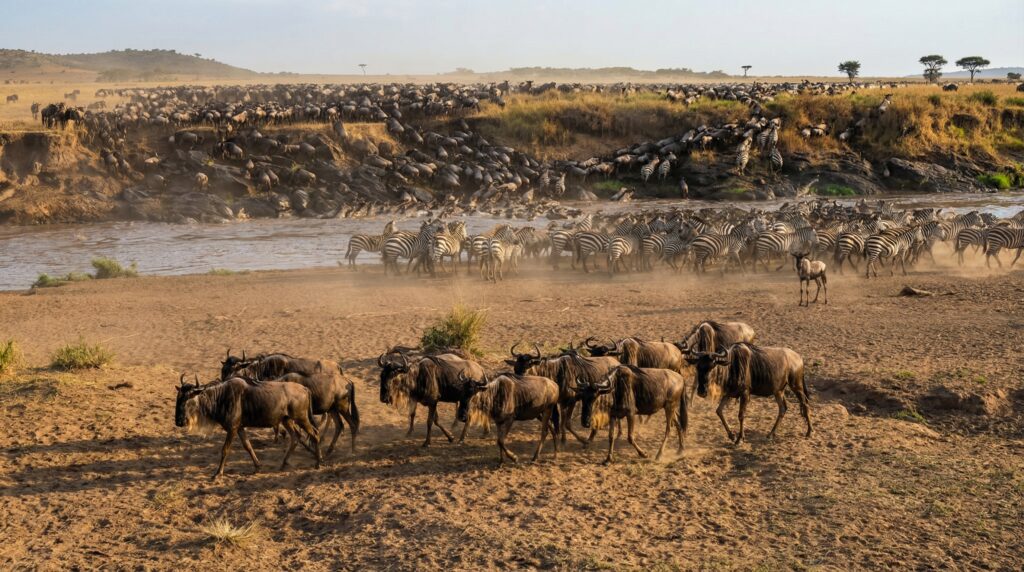
The Great Migration 2026 will reach the Maasai Mara between late June and October. Peak river crossing activity at the Talek River is expected from late July through September. For the best experience, we recommend booking your stay at Mara Big Five Camp at least 10–12 months in advance to secure prime river-front views.
The 2026 Migration Cycle: A Month-by-Month Forecast
Predicting the Great Migration (an ecosystem movement of over 1.5 million wildebeest, Connochaetes taurinus) requires an understanding of the relationship between the Serengeti and the Maasai Mara.
July 2026: The Arrival
By early July, the first herds typically appear in the southern Mara. At Mara Big Five Camp, our guides begin scouting the southern entry points near the Loita Plains. While the massive “super-herds” are still moving north, this is a phenomenal time for travelers who want to see the migration without the peak August vehicle numbers.
August 2026: The High Drama
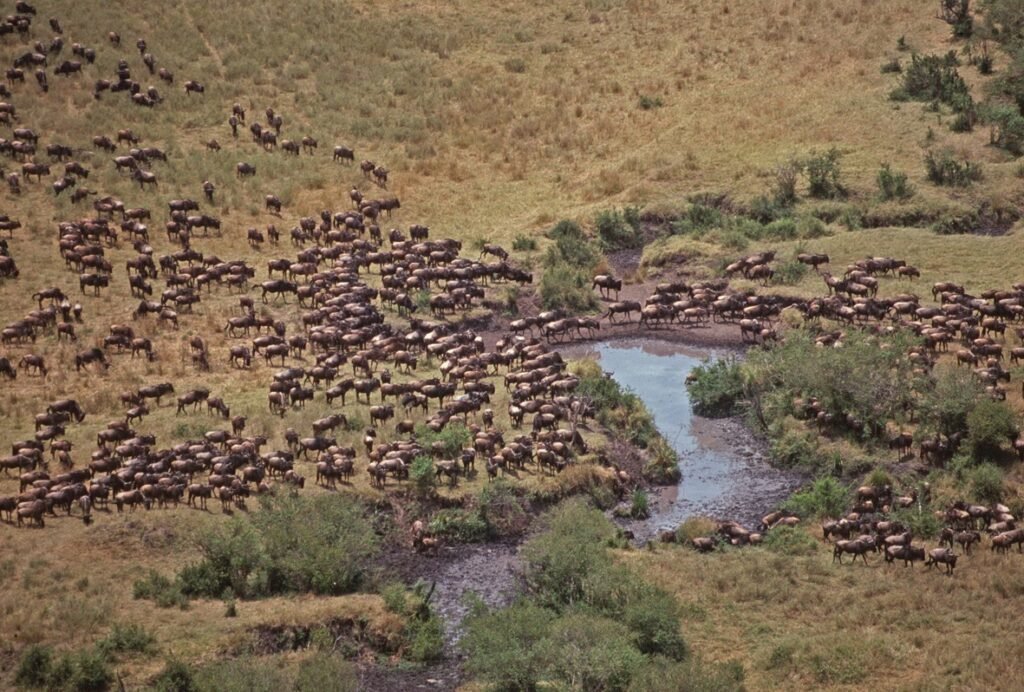
This is the peak of the river crossing season. The herds congregate at “holding sites” along the Talek and Mara Rivers. Our camp team often observes thousands of animals pressing against the banks, waiting for a single leader to dive into the water—a moment that triggers an instant, chaotic surge.
September 2026: The Photographers’ Choice
In 2026, we anticipate September to be the standout month for serious wildlife enthusiasts. The herds are fully settled into the Mara, and the predatory pressure from lion (Panthera leo) and leopard (Panthera pardus) is at its most visible. The lighting in September is often softer, providing superior conditions for capturing the scale of the movement.
October 2026: The Return South
As the short rains begin to tease the Serengeti, the herds sense the change and begin moving south. Crossings are still frequent but move with an increased urgency.
Where to Position for the Best Views
While the Mara River is famous, the Talek River corridor is arguably more active and accessible. Because Mara Big Five Camp sits directly on the Talek, our guests are often only minutes away from active crossing sites.
The Strategy of the Crossing
Our guides don’t just drive to the water and wait. We look for specific environmental cues:
- Herd Density: Is the pressure at the back of the herd forcing the front animals into the water?
- Predator Presence: Are crocodiles (Crocodylus niloticus) visible at the landing site?
- Dust Plumes: A rising cloud of dust in the distance often indicates a fresh wave of animals approaching a crossing point.
“Wild By Night”: Beyond the Crossing
The 2026 migration experience at Mara Big Five Camp is defined by our “Wild By Night” philosophy. Most camps must return to the National Reserve by sunset. Because we operate in the conservancy area, we can stay out after dark.
Imagine sitting in total darkness as the air vibrates with the low-frequency grunts of 50,000 wildebeest nearby. A night game drive allows you to see the “hidden” side of the migration—the night-time hunts of spotted hyena and the territorial movements of large pride lions that are often dormant during the hot daylight hours.
Planning Your 2026 Safari: Key Logistics
| Detail | Recommendation |
| Booking Lead Time | 12 months (highly recommended for August) |
| Minimum Stay | 4 nights to ensure multiple crossing attempts |
| Arrival Hub | Jomo Kenyatta International Airport (Nairobi) |
| Transport | Fly-in safari to Ol Kiombo or Talek airstrips |
FAQ: Great Migration 2026
How do you get to Mara Big Five Camp?
Most guests take a 45-minute scheduled flight from Nairobi’s Wilson Airport directly to the Maasai Mara. We provide transfers from the nearby airstrips to the camp, which is located near the Talek Gate.
Is Mara Big Five Camp suitable for children?
Yes, we welcome families. However, please note that the migration involves raw predator-prey interactions that can be quite intense. We recommend children be at least 6 years old to fully appreciate the safari experience.
What wildlife can you see outside Migration season?
The “Big Five”—lion, leopard, elephant (Loxodonta africana), Cape buffalo (Syncerus caffer), and the rare black rhinoceros (Diceros bicornis)—are resident year-round. Even without the migration, the Talek River area remains one of the densest wildlife zones in Africa.
Book Your Front-Row Seat for 2026
To experience the Great Migration with the expertise of a team that lives on the Talek River, we invite you to enquire about our 2026 availability. Secure your place in the heart of the action.