
If you’re planning a trip to Masai Mara, there’s one attraction you won’t want to miss. That’s the Great Migration. It’s an action-packed spectacle that features over 1.6 million wildebeests, 400,000 zebras, 300,000 gazelles, and 12,000 eland.
Crossing the Mara River is no mean feat. It’s a treacherous bed of death with fast-flowing water and steep banks that make it hard to enter and exit. And in it are Nile crocodiles that can stretch up to 6 meters in length, equipped to capture anything in their path.
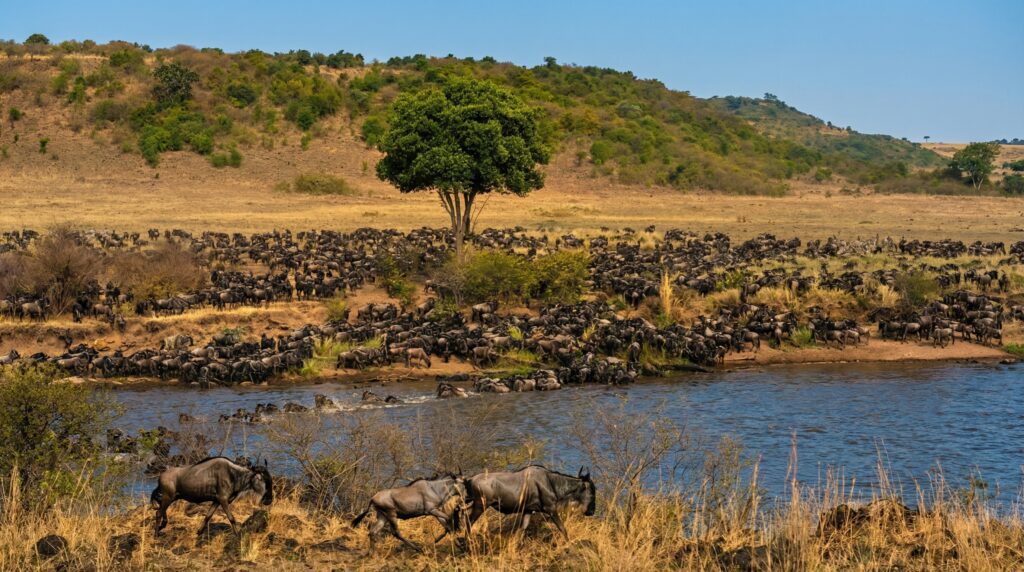
To add to the peril, lions, leopards, and other predators use the river to ambush prey. It’s a spectacle that features suspense, action, and a nervous desperation that comes with the need to survive.
With tour vehicles lining up along the main sections of the river, you may be there but miss all the drama. That’s why the Talek River Crossing, Mara’s ‘other’ river, is the ideal spot. It offers secluded, high-drama crossings and exceptional predator sightings, especially for guests staying at nearby boutique camps like Mara Big Five.
Why Our Guides Prefer the Talek River Crossing
At Mara Big Five Camp, we believe that true luxury is defined by space and silence. In recent years, the line of 50+ safari vehicles at the main Mara River has become a major deterrent for authentic travelers. By focusing on the Talek River wildebeest crossing, we provide our guests with a front-row seat to the action without the noise.
1. Intimate Sightings and Photography
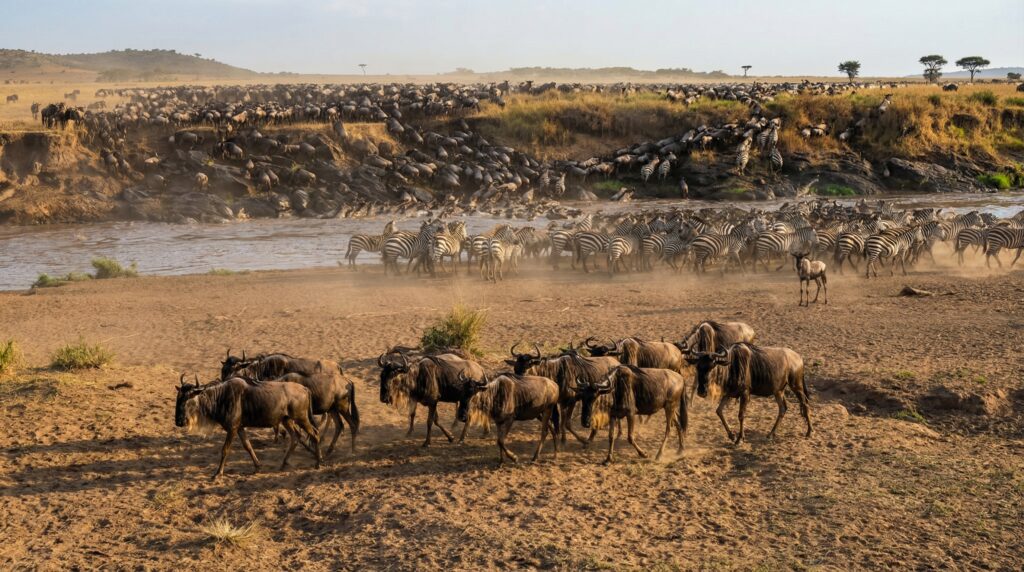
Because the Talek is narrower than the Mara River, the action is “closer to the lens.”
- The Benefit: You don’t need a massive telephoto lens to capture the raw emotion of a wildebeest leap.
- Our Experience: We often find ourselves as one of a few vehicles at a crossing, allowing us to position perfectly for the “golden hour” light.
2. The Predator “Ambush” Corridor
The dense riparian woodland lining the Talek River makes it the ultimate hunting ground. During our recent drives, we’ve noted that:
- Leopards use the thick tree canopy to scout for vulnerable calves.
- Lion prides frequently use the riverbank’s natural contours to launch ambushes.
- Resident cheetahs are often spotted on the nearby plains, waiting for the herds to emerge from the water.
Strategic Proximity: The Mara Big Five Advantage
Choosing the best Mara crossing spot is half the battle. You also need to make sure you can get there conveniently. In this regard, lodging at The Mara Big Five Camp gives you a strategic advantage. Our camp is situated directly on the banks of the Talek, giving you a tactical advantage over lodges located further away. You can reach the primary Talek River wildebeest crossing points within minutes, and more importantly, before the “gate-in” crowds from other resorts.
But that’s not the best part. You can return to camp for a gourmet lunch and a siesta, before heading back out as the herds begin to muster the courage to cross. So, book your stay at the Mara Big Five Camp for an unforgettable wildebeest migration experience.
[FAQ] Common Questions About the Talek Migration
Is the Talek River crossing as big as the Mara River crossing? While the volume of animals in a single “jump” may be smaller than the main Mara River, the frequency of crossings is high, and the lack of crowds makes the experience feel much more significant and personal.
When is the best time to see the Talek River wildebeest crossing? The peak window is between July and October. However, because our camp is located in a wildlife-rich corridor, predator action around the riverbanks is spectacular year-round.